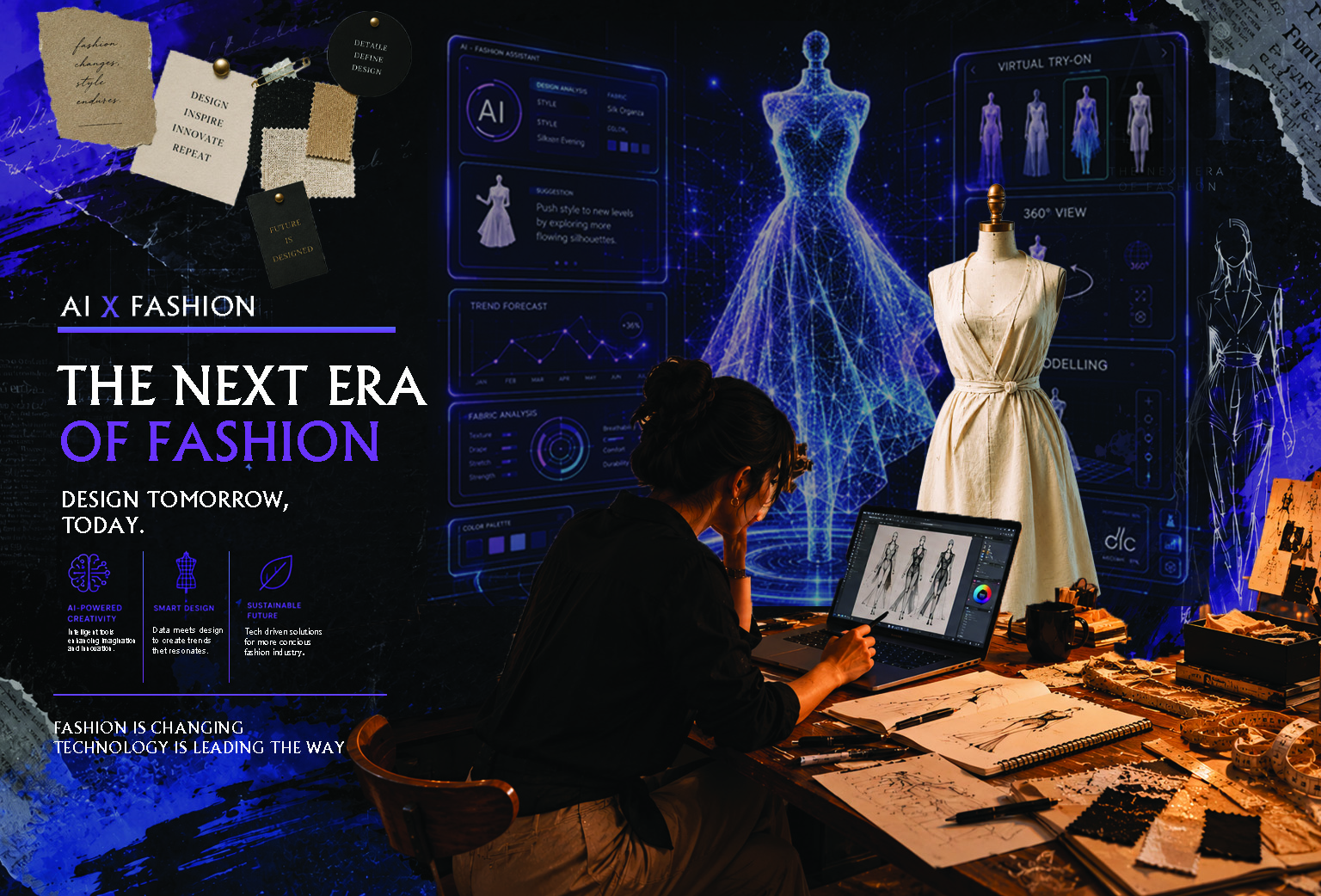
The cornerstone of the upcoming technology, artificial-intelligence, has universally shifted the perception of simplicity and convenience. In the fashion world, it has become just as integral in driving designers, customers, and retailers to perceive a futuristic approach to fashion. A fashion enthusiast is exploring the realm of virtual try-ons, 3D modelling, and 360° views of their clothing pieces. AI digitally transforms how we see fashion by replicating exactly what we have in mind or providing dimensions to fashion sketches, giving fashion tech pack designers a broad perspective on how to improve their work. However, with this new introduction, are we facing a tug of war of creativity with technology? Let’s find out.
Glittery Perception: AI Distorting Consumer POV
Traditionally, fashion originated from the genius brain of one, which is brainstormed into creation. However, with the introduction of AI, consumers can easily generate and find unique pieces of fashion that are in higher demand than the norm. Consumers have a keen eye for finding newness, and with the digital introduction, this search has only intensified. Here are some ways that AI is distorting the fashion industry from the consumer’s POV.
-
Automated Designs:
Every piece of fashion in a shop or a wardrobe is the reality of a designer that has a purpose and emotion attached to it. With artificial-intelligence, designs will be produced with a prompt backed by data fed into it that totally lacks meaning and human artistry.
-
Homogenous Data:
Fashion is all about being different and unique. With prompts, consumers may rely on fed data to deliver unique designs. However, the sad reality is that data is homogenous, and AI performs whatever existing command it has to satisfy its curiosity and not deliver originality.
-
Impersonation of Trends:
Now, all it takes is a reimagination of an outfit to create the same or duplicate it with minor changes with AI. Smaller brands have the capability to replicate the designs of higher ones with artificial-intelligence and sell them to customers, imposing the idea of getting anything they want with the help of AI at a lower price.
Prompts Taking Over Pencils
When a piece is created, careful consideration is given to its effects on the eye of the beholder, the world watching, and the industry it impacts. Every line drawn by the designer may go through 10 erases to attain perfection. But AI seems to have sorted human errors, giving the perfect illusion of providing precisely what you want with few prompts. The impact this revolutionary assistant has on designers and creators of fashion can be concerning.
-
Generative Designs:
Rather than “wasting” time and manpower into creating something original, now all it takes is a few text prompts and commands to let the AI know what you need, and voila! You now have a design ready to be made.
-
Forecasting Trends:
Traditionally, fashion was set by the designers on the basis of intuition, generational influence, and other aesthetic factors. Conversely, artificial-intelligence uses algorithm-based statistical forecasting to predict trends that may or may not be useful.
-
Fashion Prototyping:
Prototyping and patterning once required a designer’s touch, but with AI tools, they are replaced with applications that have fabric pattern designs that do the job.
Competition or Companion?
As much as AI may seem like a competition, the good news is that they can coexist. The machine-learned bot can only produce so much for consumers and designers to rely on before it repeats itself. Meanwhile, with their experience and exposure, designers have much more to contribute and create that can be unique and make exceptional pieces with a helping hand, such as an AI. Surpassing the worries, here are all the reasons why you can rely upon and accompany AI into your projects.
Advantages of Having Artificial Intelligence
-
Idea Generation:
When working on multiple projects or major projects, designers often need more inspiration or ideas to connect the dots and create their best work. In such cases, having AI provide suggestions gives designers a broader perspective and new ideas to work with. When designers are in a dilemma with trends, having an AI with a reliable database to provide swift information can be of great help.
-
Helper to Traditional Methods:
The industry has a fair share of employees who are dependent on traditional methods and repeat the same routine over and over. AI can streamline some of those tasks, maintaining a log of the tasks to cut time and effort as much as possible.
-
Experimentation:
When a designer concludes with a design, the doubt of whether it will work out or not may hover over their head. In such instances, having AI generate realistic models that offer a clear picture of the fabric texture or clothing over different parts of the body gives room for designers to improvise and create stunning works.
-
Sustainable Practices:
To continue the previous point, AI designers save paper and fabric waste. They help you optimise material usage and, if necessary, keep track of the resources you use and dispose of for healthier and more sustainable design practices.
-
Augmented Realism:
Designers can enhance creativity by bringing realism to their designs by using augmenting tools. Augmented reality can be a virtual way of storytelling behind the design concept and become a walkthrough of the designer’s mind.
-
Speed the Process and Feedback:
With digital assistance that can depict your design and make necessary tweaks to it with your commands, you can cut down hours or maybe weeks of work. Furthermore, you get feedback on the virtual project, enabling you to post it into threads once it is approved.
Verdict: Fashion and AI Can Coexist In Peace
Consumers of fashion realise how the over-consumption of AI-produced designs and styles leads to a path of monotone until it has a more human touch to create originalism. As mentioned earlier, emotions and feelings attached to a design and dress are what make it wearable and trendy. Thus, the fear of AI misconstruing perceptions is a far thought.
While fashion designers and enthusiasts can do the hand and brain work to create wonderful pieces that can be set out to become the new trend, AI can automate repetitive tasks and utilise algorithms to ensure physically tiring tasks are taken care of.